A commitment to innovation and sustainability

Are you ready to embark on a journey through the vast and dynamic world of social networking? Look no further – you’ve arrived at The Social Networking Navigator, your ultimate guide to navigating the digital landscapes where connections, conversations, and communities thrive.

About Us:

At The Social Networking Navigator, we understand that the digital realm can be overwhelming. With countless platforms, features, and trends emerging constantly, it’s easy to feel lost. That’s why we’re here – to be your compass in the social media universe.

What We Offer:

  1. Platform Guides: From the familiar giants like Facebook and Instagram to the up-and-coming platforms making waves, we provide comprehensive guides to help you understand each platform’s unique features, audience, and best practices.

  2. Trending Topics: Stay ahead of the curve with our curated content on the latest social media trends, viral challenges, and emerging technologies. Be the first to know what’s buzzing in the digital world.

  3. Tips and Tricks: Unlock the full potential of your social media presence with our expert tips and tricks. Whether you’re an individual looking to enhance your personal brand or a business aiming to strengthen its online presence, we’ve got you covered.

  4. Security and Privacy: Navigating the digital landscape requires careful consideration of security and privacy. Our guides will help you understand the best practices to keep your online presence safe and secure.

  5. Community Corner: Connect with like-minded individuals in our Community Corner. Share your experiences, ask questions, and learn from others who are navigating the same social networking waters.

Why Choose The Social Networking Navigator?

  1. Reliable Information: Our content is carefully curated, ensuring that you receive accurate and up-to-date information about the ever-evolving world of social media.

  2. User-Friendly Interface: Navigating our website is as seamless as the advice we provide. Find what you need easily with our intuitive design and user-friendly interface.

  3. Dedicated Support: Have a question or need assistance? Our dedicated support team is here to help you on your journey. Feel free to reach out, and we’ll guide you every step of the way.

Stay Connected, Stay Informed:

Follow The Social Networking Navigator for your passport to the digital world. Whether you’re a social media enthusiast, a business professional, or someone just getting started, we’re here to help you navigate the ever-expanding universe of social networking.

Embark on your digital adventure with confidence – let The Social Networking Navigator be your guiding star. Start exploring today!

How to Trace a Health Post Back to Its Original Source

A health post can travel through a video, a screenshot, a news story and a newsletter before it reaches your feed. Each version may preserve the headline while losing the original study. Finding that study is a separate task from deciding whether its findings are convincing. Start by rebuilding the trail.

You do not need to become an expert in every topic that appears online. You need enough information to identify where a particular claim came from and whether the source actually addresses it. The following workflow uses a fictional post about a biological signal and a social activity; it makes no claim about a real intervention.

Save the claim in its original form

Write down the sentence you want to investigate, the account that posted it and the date you saw it. If a screenshot includes a chart, preserve its title, axes and caption. Cropping away those details can remove the very information needed to identify the source. Record the visible wording before replacing it with your own interpretation.

For the fictional example, suppose a post says that a group activity “changes a brain peptide and improves connection.” That sentence contains at least two claims: a molecular measurement and a social outcome. Make a separate line for each. The post may cite a study that measured one but only discussed the other.

Also note whether the account provides a direct citation, names a researcher or simply says “science shows.” An absent citation does not tell you that a claim is false. It tells you that the route to its evidence is incomplete and that you should avoid treating the post itself as the study.

Follow each link without skipping a layer

Open the linked page and look for its own source. A news article may link to a university announcement, which may then identify a journal paper. Record the chain in order. A short list of page title, date and outgoing citation is enough; the goal is to distinguish the origin of the claim from later retellings.

The MedlinePlus guide to evaluating health information encourages readers to examine who provides information and the evidence behind it. For a source-tracing task, turn that principle into a practical question at each step: does this page report original work, explain someone else’s work, or merely repeat the statement?

Do not count five pages repeating the same announcement as five independent studies. They may all lead to one experiment. Conversely, a summary may combine several papers; in that case, connect each claim to the paper that actually supports it instead of attaching the entire summary to the first citation you find.
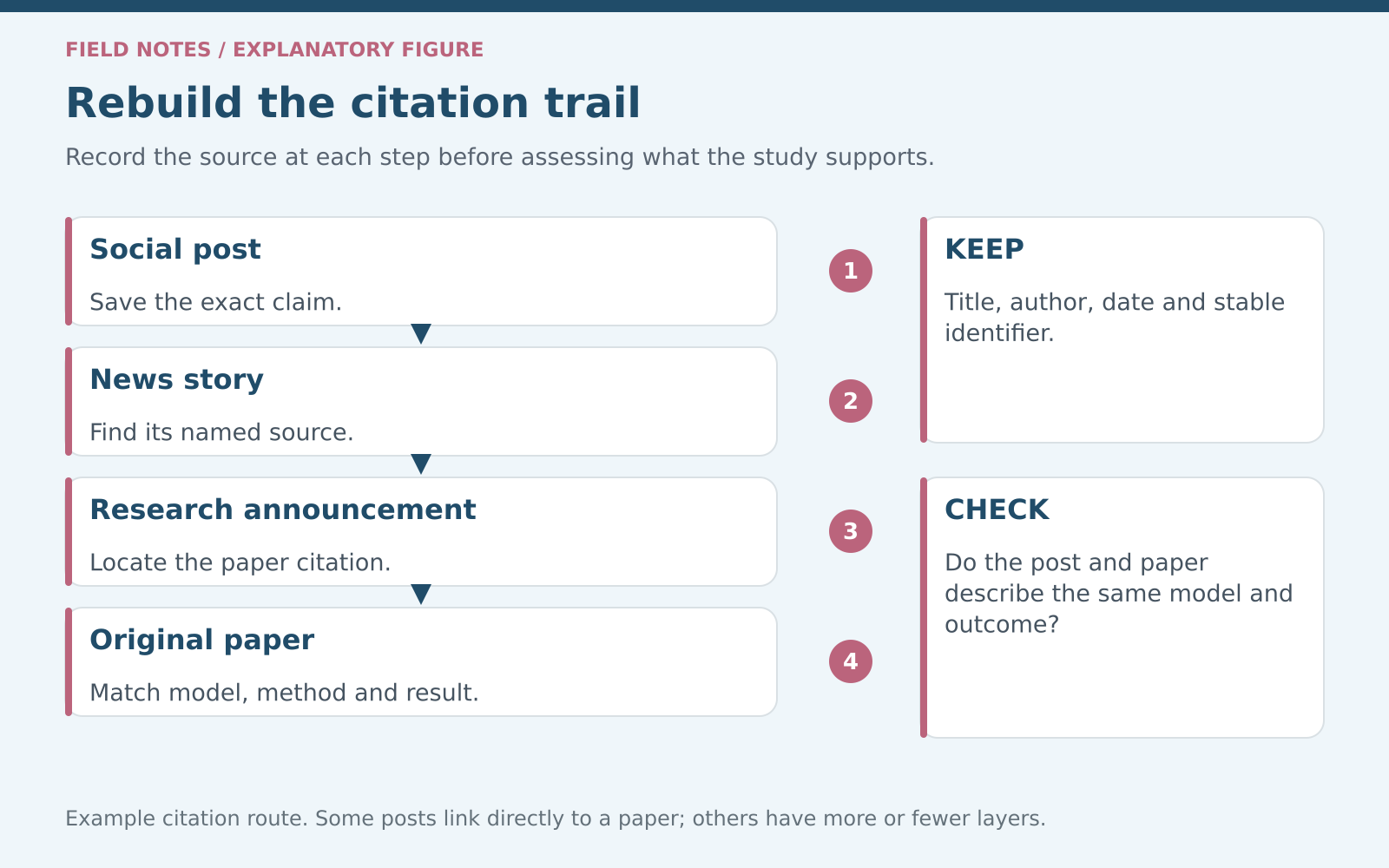
Four source-tracing cards lead from a social post through a news story and research announcement to the original paper.
A conceptual source trail helps distinguish repeated coverage from the underlying study. Image credits.

Search using distinctive details

If the link trail stops, search a short distinctive phrase alongside a named author, institution or journal. A generic search for “peptide social benefits” invites a wide range of unrelated material. A paper title, unusual task name or specific measurement is more likely to identify the intended record.

When the subject is biomedical, a publication database can help. The official PubMed help page explains searching and citation tools. A PubMed record can supply a title, authors, publication details and identifiers such as a PMID or DOI. Those identifiers are useful for keeping two similarly titled papers separate.

Being indexed is not a guarantee that a paper’s conclusion is correct. At this stage, the database solves an identification problem. Save the exact record and then ask what kind of publication it is: an original experiment, a review, a commentary or another article type. Each has a different relationship to the underlying evidence.

Match the claim to the study, field by field

FieldQuestion to answer
Participants or modelHumans, another species, tissue or cultured cells?
Activity or exposureWhat actually happened in the study?
MeasurementWhich molecule, sample or behavioural test was used?
ComparisonWhat was the reference condition?
ConclusionWhat did the authors directly report?

Return to the fictional post. If the paper measured a peptide in blood, “changes a brain peptide” is already a broader statement. If it recorded a questionnaire score, “improves connection” may conceal the exact outcome. These mismatches are visible only after the post and the paper are placed side by side.

A useful note has three columns: original wording, study wording and unresolved difference. Do not rewrite the original post to make it sound more defensible. Preserve the discrepancy so that another reader can see how the claim changed during its journey.

Recognize when the trail remains incomplete

Sometimes the record is identifiable but the full paper is unavailable. The abstract may answer basic questions while leaving important methods unresolved. Mark those questions as unanswered. Do not reconstruct a detailed protocol from a short summary or assume that an inaccessible table contains the comparison you hoped to find.

Other times, several studies fit the description and no citation distinguishes them. Save the plausible candidates separately. A confident match requires distinctive agreement, not just a similar topic. You can still report that the post lacks enough information to identify its source without declaring that every possible underlying claim has been disproved.

Look for linked corrections, updates or related publication notices on the record. The source trail is a record of a publication as it exists now, not merely the first version that circulated. Include the date of your check in your notes if the result will be used in an editorial workflow.

Keep the original study title in the notes even if it is long. A shortened headline is easier to read but may remove the species, method or qualifier that distinguishes the paper from related work. Store the short summary and the exact citation as separate fields so each can do its own job.

Share a traceable summary

A short, useful summary names the study, states the model and measurement, and describes how the social post differs. For example, an invented summary could say that a post refers to a blood-sample study, while its headline describes brain signalling that the study did not directly measure.

Keep the link to the original record beside that explanation. This gives the next reader a route they can check rather than another detached assertion. Source tracing does not settle every scientific debate, but it removes a common obstacle to understanding one: uncertainty about which experiment the conversation is actually discussing.

The Unlikely Nexus: Social Networking and Steroid Talks

In the ever-evolving landscape of social networking, conversations span a wide spectrum of topics, from the mundane to the extraordinary. One unexpected area gaining traction within these digital communities is the discussion around where to buy tren – the most powerful steroid. Once confined to niche forums and discreet gym corners, steroid talks have found an unlikely home in the vast and interconnected world of social media.

The Rise of Steroid Discourse on Social Networks:

  1. Anonymity and Open Conversations: Social networks provide a veil of anonymity that empowers users to openly discuss subjects that were once considered taboo. Steroid talks, previously relegated to hushed gym whispers, now unfold on public forums where individuals share their experiences, knowledge, and questions without fear of judgment.
  2. Community Building and Support: Online communities centered around fitness and bodybuilding have flourished on platforms like Instagram, Twitter, and Reddit. These communities act as a support network for individuals contemplating or currently using steroids, fostering an environment where users can share advice, personal stories, and encouragement.
  3. Access to Information: The internet has democratized information, and social networks play a pivotal role in disseminating knowledge about steroids. Users can access a wealth of information, ranging from the science behind steroids to detailed accounts of personal experiences, contributing to a more informed and nuanced conversation.
  4. Influencers and Fitness Gurus: Social media influencers and fitness gurus wield considerable influence over their followers. Some are candid about their use of steroids, sparking discussions on the ethics, risks, and benefits associated with these substances. This transparency, while controversial, has brought the topic into mainstream discourse.

Challenges and Concerns:

  1. Misinformation and Lack of Regulation: The open nature of social networks also exposes users to misinformation and potentially harmful advice – for example the topic that is usually discussed is where to buy tren. Unfortunately, not all of the promoted places are legit. With limited oversight, there’s a risk that individuals may follow misguided recommendations, leading to health issues or legal consequences.
  2. Normalization and Peer Pressure: The normalization of steroid talks on social media can inadvertently create an atmosphere of peer pressure, with users feeling compelled to conform to perceived standards of physical perfection. This pressure can contribute to the misuse and abuse of steroids, posing serious health risks.
  3. Legal Implications: Publicly discussing or promoting the use of steroids may have legal ramifications, as the sale and distribution of these substances are often regulated. Users may unwittingly expose themselves to legal consequences by openly sharing their experiences on social networks.

The intersection of social networking and discussions about steroids highlights the changing landscape of online conversations. While these platforms provide opportunities for meaningful exchanges on topics like Anavar for sale online or insights from sources such as Mister Olympia shop, they also introduce challenges tied to misinformation, social pressure, and potential legal risks. As social media continues to influence dialogues around fitness and health, it becomes essential to encourage responsible discussions while being mindful of the dangers associated with sharing sensitive or misleading information in such open forums.

Steroids for Women: Navigating the Steroid Discussion in Social Media

In the dynamic world of fitness and wellness on social media, the dialogue around steroids has taken a spotlight, especially in the context of women breaking traditional norms. This blog post aims to delve into the unconventional, exploring the complex interplay between steroids for women(https://www.ndtv.com/partner-content/health-supplements/best-steroids-for-women-2024-top-5-best-female-steroid-cycles-for-weight-loss-and-muscle-growth-4922914), female empowerment, and the evolving landscape of social media.

Unveiling Unconventional Fitness Narratives:

As the fitness space becomes more diverse, a new wave of influencers challenges conventional norms and sparks conversations on topics that were once considered taboo. Women who openly discuss their journey with steroids on social media are redefining what it means to be empowered, shattering stereotypes, and encouraging a more inclusive dialogue.

From Stereotypes to Authenticity:

In a world saturated with curated images and stereotypical ideals, some women are choosing authenticity over conformity. The decision to embrace steroids becomes a radical act of self-expression, challenging preconceived notions of beauty and strength. By sharing their stories, these women contribute to a narrative that celebrates uniqueness and resilience.

Navigating the Double-Edged Sword:

The use of steroids in women comes with both potential benefits and risks, making it a double-edged sword in the pursuit of fitness goals. This blog post encourages a nuanced understanding, emphasizing the importance of informed decisions, responsible use, and the significance of prioritizing health over societal expectations.

For those exploring testosterone blends, questions like how often to inject sustanon 250 frequently arise, highlighting the need for medical guidance and individualized protocols.

The Intersection of Body Positivity and Steroid Use:

The body positivity movement has gained momentum, promoting self-love and acceptance. How does steroid use fit into this narrative? Can women who choose steroids still embrace body positivity? This blog post explores the evolving definition of body positivity and challenges the dichotomy between natural and enhanced bodies.

Fostering a Supportive Community:

While the fitness community on social media can be both empowering and polarizing, creating a space that embraces diversity is essential. Encouraging open conversations, providing support without judgment, and acknowledging the uniqueness of each fitness journey fosters a community where women can feel empowered to make choices that align with their individual goals.