

A health post can travel through a video, a screenshot, a news story and a newsletter before it reaches your feed. Each version may preserve the headline while losing the original study. Finding that study is a separate task from deciding whether its findings are convincing. Start by rebuilding the trail.
You do not need to become an expert in every topic that appears online. You need enough information to identify where a particular claim came from and whether the source actually addresses it. The following workflow uses a fictional post about a biological signal and a social activity; it makes no claim about a real intervention.
Save the claim in its original form
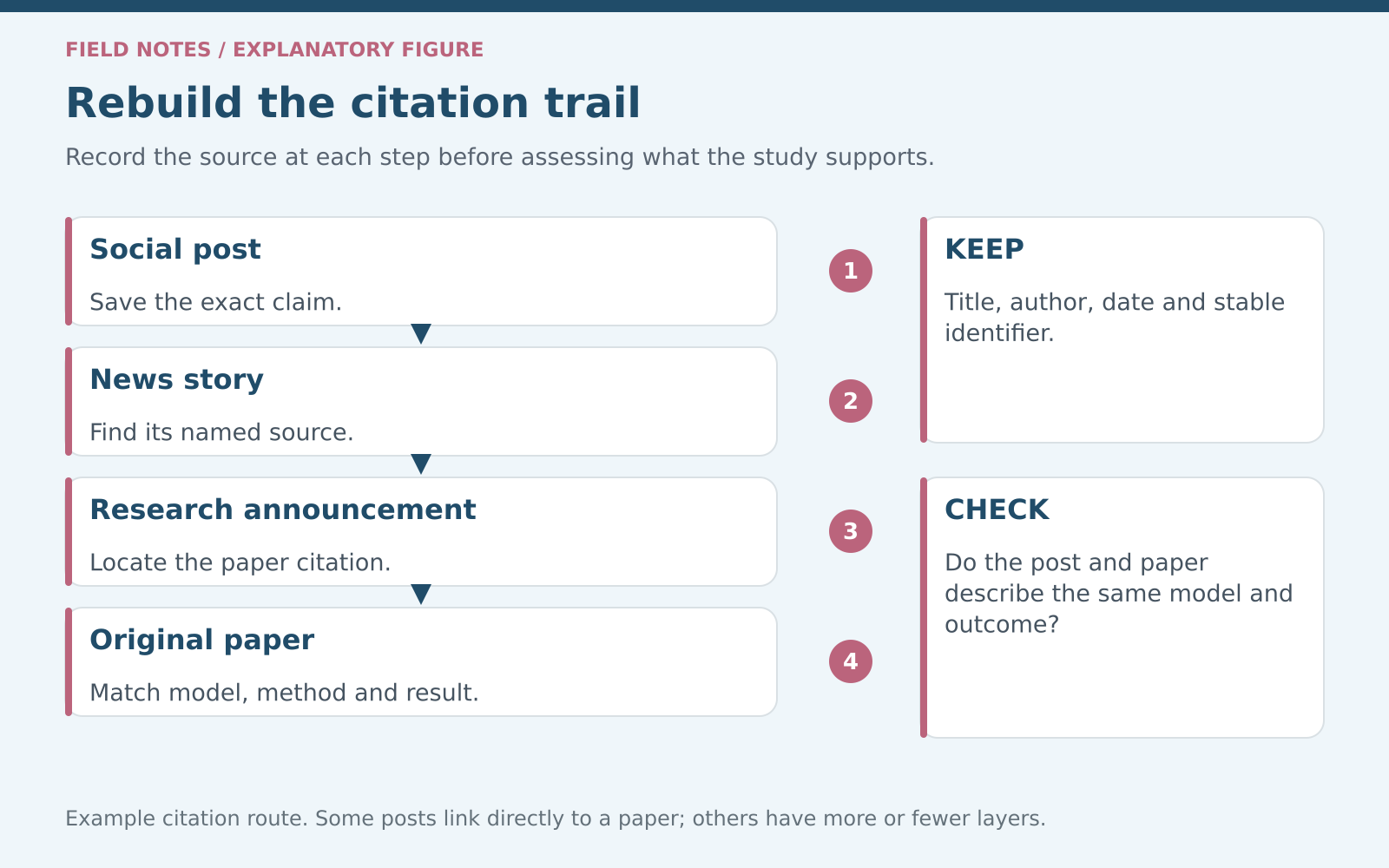
Write down the sentence you want to investigate, the account that posted it and the date you saw it. If a screenshot includes a chart, preserve its title, axes and caption. Cropping away those details can remove the very information needed to identify the source. Record the visible wording before replacing it with your own interpretation.
For the fictional example, suppose a post says that a group activity “changes a brain peptide and improves connection.” That sentence contains at least two claims: a molecular measurement and a social outcome. Make a separate line for each. The post may cite a study that measured one but only discussed the other.
Also note whether the account provides a direct citation, names a researcher or simply says “science shows.” An absent citation does not tell you that a claim is false. It tells you that the route to its evidence is incomplete and that you should avoid treating the post itself as the study.
Follow each link without skipping a layer
Open the linked page and look for its own source. A news article may link to a university announcement, which may then identify a journal paper. Record the chain in order. A short list of page title, date and outgoing citation is enough; the goal is to distinguish the origin of the claim from later retellings.
The MedlinePlus guide to evaluating health information encourages readers to examine who provides information and the evidence behind it. For a source-tracing task, turn that principle into a practical question at each step: does this page report original work, explain someone else’s work, or merely repeat the statement?
Do not count five pages repeating the same announcement as five independent studies. They may all lead to one experiment. Conversely, a summary may combine several papers; in that case, connect each claim to the paper that actually supports it instead of attaching the entire summary to the first citation you find.
Search using distinctive details
If the link trail stops, search a short distinctive phrase alongside a named author, institution or journal. A generic search for “peptide social benefits” invites a wide range of unrelated material. A paper title, unusual task name or specific measurement is more likely to identify the intended record.
When the subject is biomedical, a publication database can help. The official PubMed help page explains searching and citation tools. A PubMed record can supply a title, authors, publication details and identifiers such as a PMID or DOI. Those identifiers are useful for keeping two similarly titled papers separate.
Being indexed is not a guarantee that a paper’s conclusion is correct. At this stage, the database solves an identification problem. Save the exact record and then ask what kind of publication it is: an original experiment, a review, a commentary or another article type. Each has a different relationship to the underlying evidence.
Match the claim to the study, field by field
| Field | Question to answer |
|---|---|
| Participants or model | Humans, another species, tissue or cultured cells? |
| Activity or exposure | What actually happened in the study? |
| Measurement | Which molecule, sample or behavioural test was used? |
| Comparison | What was the reference condition? |
| Conclusion | What did the authors directly report? |
Return to the fictional post. If the paper measured a peptide in blood, “changes a brain peptide” is already a broader statement. If it recorded a questionnaire score, “improves connection” may conceal the exact outcome. These mismatches are visible only after the post and the paper are placed side by side.
A useful note has three columns: original wording, study wording and unresolved difference. Do not rewrite the original post to make it sound more defensible. Preserve the discrepancy so that another reader can see how the claim changed during its journey.
Recognize when the trail remains incomplete
Sometimes the record is identifiable but the full paper is unavailable. The abstract may answer basic questions while leaving important methods unresolved. Mark those questions as unanswered. Do not reconstruct a detailed protocol from a short summary or assume that an inaccessible table contains the comparison you hoped to find.
Other times, several studies fit the description and no citation distinguishes them. Save the plausible candidates separately. A confident match requires distinctive agreement, not just a similar topic. You can still report that the post lacks enough information to identify its source without declaring that every possible underlying claim has been disproved.
Look for linked corrections, updates or related publication notices on the record. The source trail is a record of a publication as it exists now, not merely the first version that circulated. Include the date of your check in your notes if the result will be used in an editorial workflow.
Keep the original study title in the notes even if it is long. A shortened headline is easier to read but may remove the species, method or qualifier that distinguishes the paper from related work. Store the short summary and the exact citation as separate fields so each can do its own job.
Share a traceable summary
A short, useful summary names the study, states the model and measurement, and describes how the social post differs. For example, an invented summary could say that a post refers to a blood-sample study, while its headline describes brain signalling that the study did not directly measure.
Keep the link to the original record beside that explanation. This gives the next reader a route they can check rather than another detached assertion. Source tracing does not settle every scientific debate, but it removes a common obstacle to understanding one: uncertainty about which experiment the conversation is actually discussing.